Spare parts kit
Protective windows, nozzles, focus optics and seals, priced and listed with a lead time per item. Sized to the number of units in the field.
Products
Continuous wave moves material at speed. Pulsed removes a layer without putting heat into the part. A buyer who is offered the wrong one will conclude that laser cleaning does not work.
Line 01 · Continuous wave
For work where the machine has to keep up with a production schedule: hull plates, structural steel, tank shells, tower sections. The limit is usually the operator's arm, not the source.
At 3 kW the economics change. The comparison stops being laser against sandpaper and becomes laser against a blasting crew with its containment, waste disposal and permit obligations.
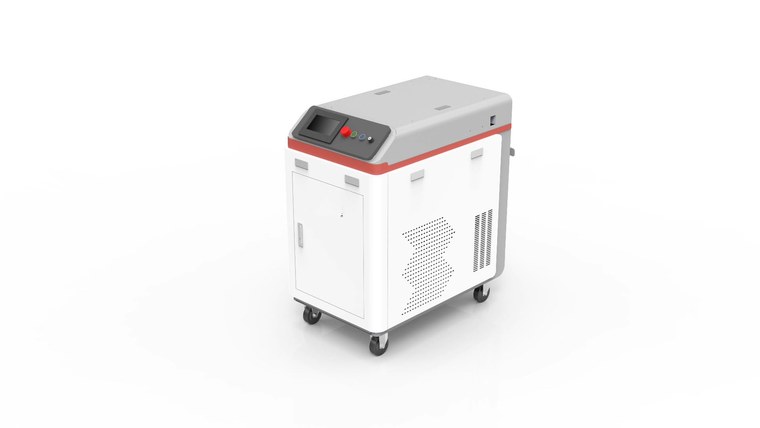
3 kW continuous wave: rust off in a single pass. Parameters on request with the datasheet.
| Parameter | Specification |
|---|---|
| Laser power | 1,500 / 2,000 / 3,000 W |
| Laser type | Fiber, 1,080 nm |
| Power adjustment | 10 – 100 %, gradient adjustable |
| Power stability | < 5 % (3 kW unit) |
| Scan width | 5 – 300 mm, continuously adjustable |
| Delivery fiber | 10 m standard; 15 / 20 m optional |
| Cooling | Water, integrated chiller |
| Supply | 220 V 1-phase (1.5 / 2 kW) · 380 V 3-phase (3 kW), 50 / 60 Hz |
| Weight | ≈ 190 kg (3 kW cabinet) · 1.9 kg cleaning head |
Figures from the factory datasheet of the Smart HC series. Full datasheet and the third-party CE test reports on request — see Compliance.
Line 02 · Pulsed
For work where the substrate matters more than the speed: moulds, tooling, thin sheet, weld seams, coated parts. The layer comes off; the base material does not change colour, warp or anneal.
This is also the line where export classification has to be settled before anything else, because in this power class the answer depends on pulse characteristics rather than output alone. We confirm it in writing, per configuration, before a quotation is issued.
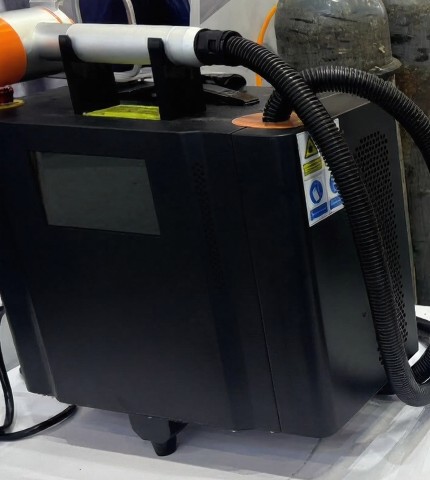
| Parameter | Specification |
|---|---|
| Average power | 100 / 200 / 300 W (500 W class on request) |
| Pulse energy | up to 1.5 mJ |
| Pulse width | 150 – 190 ns, adjustable |
| Beam quality | M² < 1.8 |
| Repetition rate | 5 – 200 kHz, gradient adjustable |
| Scan range | 0 – 150 mm · 8 scan modes · 3,000 – 10,000 mm/s |
| Delivery fiber | 3.5 m |
| Cooling | Air (four exhaust vents, no chiller) |
| Supply | AC 100 – 240 V, 50 / 60 Hz, < 750 W |
| Weight | 25 kg machine · 1.0 kg cleaning head |
Figures from the factory datasheet of the Smart HP series. Pulsed units in this class can fall under dual-use controls depending on pulse width and beam characteristics — we state the classification before quoting, see Compliance.
Options
None of these are extras in the sense of being optional for a distributor. They are the difference between selling a machine and supporting a fleet.
Protective windows, nozzles, focus optics and seals, priced and listed with a lead time per item. Sized to the number of units in the field.
Local extraction at the head for paint and coating removal, where the residue cannot be released into the workshop.
Flange, cabling and I/O for integration into an automated cell — the configuration most often requested by integrators rather than end users.
Parameter setting by substrate and layer, plus a maintenance routine the operator can follow without calling anyone.
Operation manual, maintenance schedule and the technical file required to place the unit on the EU market under your own name.
Housing colour, decals and manual branding for private-label programmes. The machine is the same; the identity is yours.
To quote
Most quotations in this category are wrong because one of these was missing. Send them and the reply is a configuration, not a brochure.
State the power and the substrate. We will send the configuration, the options list and indicative pricing.
Request a spec sheet